Experience planes big 4: the who, what, where and why of experiences
Recently, I was talking to a client and the issue of customer experience came up. They said “we do need to fix the customer experience.” Others nodded. And from that moment on, the conversation was about people, the customer: their frustrations, their expectations, their satisfaction scores. A useful conversation, no doubt about that.
But what struck me once more was what the client didn’t bring forward initially. For example, where these customers were when the frustration happened and what they were trying to get done. And finally linking it back to why the organization was offering the experience in the first place.
This wasn’t the first time. When people talk about experiences, they typically pick one view, one lens: the customer experience, the shopping experience, the brand experience, the home experience. And that initial choice of how you focus on an experience, you can think of them as experience lenses, is often made without anyone noticing. It does quietly shape the whole conversation that follows. It sets the broad direction of a potential design solution before it’s even started.
The Experience Lenses
Let’s look at a few examples of an experience lens:
the Customer experience: we talk about the human element and who the customer is, what they feel, and if they are satisfied.
Shopping experience: we talk about the store, the e-commerce website, product placement, the checkout experience.
Home experience: we talk about the family, quality time with friends, the interior design of the living room, placement of things in the kitchen.
Brand experience: we talk about the brand promise, value proposition and how the organization engages with customers, employees and partners.
All these conversations, these lenses, are useful. None of them are wrong. But each one is part of a bigger picture. And on top of that, then there is this: the person on the other side doesn’t necessarily experience things through your lens. They experience for example a different lens first, in a different sequence, or over a longer period of time.
So instead of choosing one specific lens, I’d like us to consider four Experience planes every time we consider the experience of a product or service.
The Four Experience Planes
In this framework, I propose three major planes for every type of experience lens: people, activities, and places. An easy way to think of this is as a PERSON, doing SOMETHING, SOMEWHERE. And the fourth plane: the organization’s reason for being there, their mandate, the value proposition, brand promise, and business model, and you get the four planes containing the experience lenses:
Home, car, store, office, airport, campus, a screen in someone’s hand, …
Why (Organization, Business)
Why does the organization offer it, and why would people care?
Brand promise, value proposition, business model, organizational mandate
The customer lens lives on Who, the shopping lens on What and Where, the home lens on Where and Who, and the brand lens on Why. The point isn’t to throw away your lens. It’s a “yes, and.” Keep it, and then ask what’s on the other three planes?
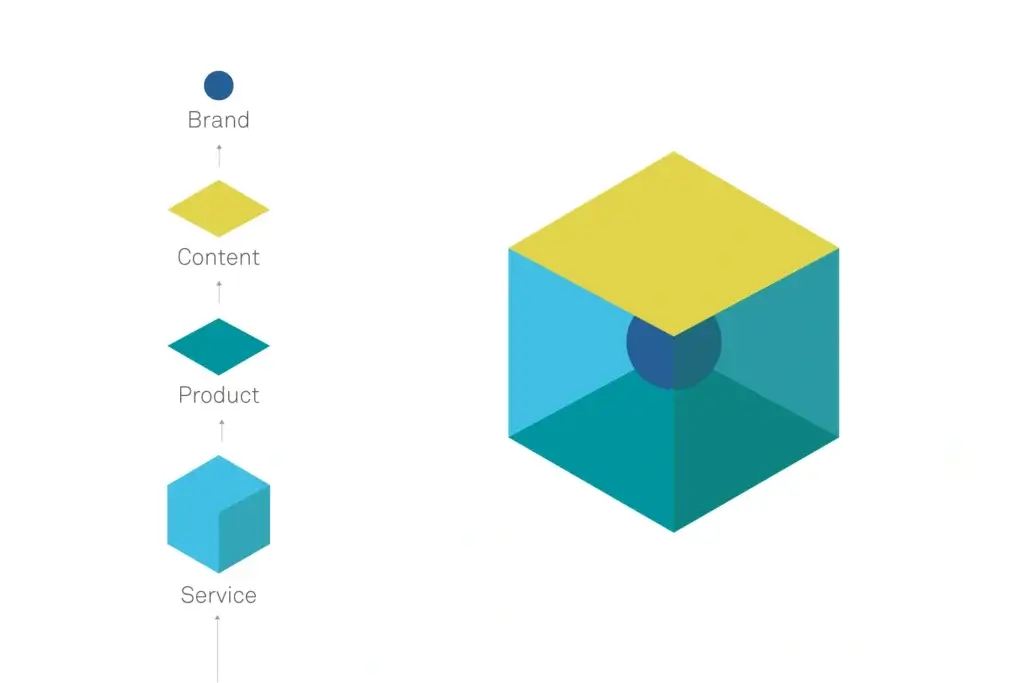
On each plane, one or more experience lens guide our thinking. What we place on each plane in term of design solutions – that’s when the four experience quadrants come into play:
Brand: the promise to your audience
Content: the information, language, data, and wisdom shared
Product: the thing that has to work (digital or physical)
Service: the end-to-end design including all of the above – following a red thread
Experience Quadrants
Let me make all this more concrete with some example experiences and journeys.
Example 1: Renewing my driver’s licence (government service)
A typical driver’s licence lifecycle: become aware, explore, know, apply, benefit, renew, replace, cancel. Most teams zoom straight in on the “renew” phase, and it is happening on the website.
Who: A current driver. This is similar to a customer; it’s the person we need to engage in to trigger the renewal. Usually that is through a reminder post card or email. They quickly become a user trying to finish a task. Within that role there’s variety: the commuter who renews in five minutes, the senior with a new medical condition, the newcomer who isn’t sure what’s different.
What: Renewing their licence, but also the smaller tasks and journeys inside it: checking eligibility, finding the reminder, filling out the forms, paying, sometimes getting a new photo. In Ontario, Canada, for instance, a licence is valid for five years, online renewal is limited to drivers who haven’t changed their address in the last 90 days and don’t need tests, and you “may need to take a new driver’s licence photo every 10 years.” That one rule decides which Where you end up in.
Where: The kitchen table with a laptop, or a service centre in the municipality with a queue. Two very different places, one goal, different experiences.
Why: Government mandate: road safety and verified identity, delivered efficiently. For government, the questions become this: Are we meeting our mandate?
Experience quadrants:
Brand sets the expectation of a government that is well run and respects your time.
Content is a huge part of the experience: whether people understand “trillium number,” and whether the photo you brought is following the rules before you waste a trip or bringing additional identification with you.
Product is the online form, the payment, the temporary license you receive in the service center, the mailed out renewed license, the kiosk system in the service center, the ticket machine to get you to the right lineup.
Service includes the connectors between online and in person. E.g. when the online system informs the driver that they are “not eligible online,” does it hand them off gracefully, with an appointment, or does it simply drop them and make them fend for themselves?
The insight: most of the frustration with renewals isn’t on the What plane. It sits in the connector between two Where’s. Being hopeful, you can do this online only to find that you still have to make a visit to the service center.
Example 2: Renewing my home mortgage (financial service)
Through the customer lens, a renewal looks like a retention moment: send an offer, keep the client, refresh your relationship with that client. In reality, this experience misses most of that retention opportunity.
Who: Not one person but heads of household, often two partners and sometimes a broker. The same person moves from user to client back to customer in evaluation mode: “you become a user… then after a while you start to wonder, ‘Was it worth it?’ And then you turn slowly into a customer again.”
What: Comparing, deciding fixed or variable, re-qualifying, signing. Underneath sits a bigger activity: re-planning the household budget. That weight is real nowadays after years of interest reduction, the pendulum is swinging the other way.
Where: For one, the home, very literally. The asset being financed is the place where the decision gets made, often late in the evening at the dining table, as well as at the bank branch, through the mobile app, and/or a phone call.
Why: The bank’s promise of trust and partnership. Here the brand promise is put to the test. Do they still deliver?
Experience quadrants:
Brand is whether “we’re with you for the long term” survives past the renewal letter?
Content is providing plain-language payment scenarios and explanations. The small print still rules.
Product is the comparison online tool, the office to meet the broker or financial advisor, the stack of papers to sign and increasingly the e-signing tools.
Service connects the branch, the advisor, and the app, so a client isn’t treated the same as a first time customer at each experience point.
The insight: a renewal is a major moment happening on the Where plane of the home or an office. Design in equal amounts for the dining table and the online dashboard.
Example 3: Ordering food from home (shopping mobile app)
In this example, the obvious lens is shopping: understand menu options, use filters, make choices, checkout. All important, and familiar territory.
Who: The hungry person holding the phone, but is often not alone. There may be a partner who “doesn’t care, anything is fine,” kids with opinions, friends coming over. Also the courier and the restaurant staff, cooks, people who are key parts of the experience who are easy to forget.
What: Deciding (the hardest part), ordering, paying, waiting, receiving, eating together, and later reordering or reviewing. It mirrors the restaurant lifecycle (trigger, research, travel, order, enjoy, pay, review), with the travel moved to someone else.
Where: The couch, not “on the go.” Mobile may be defined as “on the go,” but what if the app is most frequently used on the couch? It may not be that ‘mobile’ at all. Also, the hand-off moment, either in person or at a distance, which could be the front door or apartment lobby.
Why: The brand promise is about convenience and a good evening, not about food logistics.
Experience quadrants:
Brand sets the tone: Friday-night treat, or functional fuel?
Content covers mobile app descriptions, menus, photos, dietary information, honest delivery-time estimates and the little note from the restaurant thanking you for your business.
Product is the user experience or app including group ordering and the tracking screen showing progress. The food quality, temperature and the containers. Also, the recycle/reuse potential of the packaging.
Service connects app, restaurant, and courier experiences into one red thread, so everything happens as expected and e.g a late order is successfully handled before it spoils your evening.
The insight: the app isn’t primarily competing on ease of shopping, it’s competing on the home experience. A flawless checkout won’t make up for a cold dinner arriving 40 minutes late with the family already hungry and irritated.
Example 4: Youth mental health support addressing isolation and loneliness in a city (government, NGO, private sector service)
This is the example where using a single lens is most risky. In this case, that’s the patient. The default designers tend to use is a clinical lens: a patient, an appointment, an intake form.
Who: A young person, say 19, recently moved to the city for school or work. They don’t see themselves as a “patient.” They might be “someone who’s a bit lonely.” Around them: roommates, parents far away, peers, counsellors, and community and campus staff.
What: Not “accessing services.” The real activities are recognizing not feeling right, searching privately (often at night), taking a tiny first step, showing up somewhere, and coming back a second time. The second time is where most services lose people.
Where: The bedroom with a phone at 1 a.m. The commute. The campus. And the places the city offers, or doesn’t: the community centre, the library, the drop-in group, the sports field. For loneliness, the Where plane is a critical part of the treatment.
Why: The mandate can be wellbeing and belonging, measured by connection. The return on experience in non-profit work may be measured by engagement and recommendations.
Experience quadrants:
Brand has to feel like an invitation, a gentle nudge, not a diagnosis. Tone of voice is everything in this case.
Content speaks the young person’s language (“feeling disconnected,” not “social isolation intervention”).
Product is the low-barrier digital entry point: anonymous chat, a group finder but also the leaflet in the hallway of a college corridor, a sign at the entrance of the student councillor office.
Service is the connector from screen to place to people, such as a warm hand-off from chat to a real group with a named person waiting.
The insight: if you design this only on the Who plane, you build better intake. If you add Where, you start designing end to end and take someone to where you need them to be. And able to handle the situation successfully.
Example 5: Unboxing and setting up a new phone (physical/digital product experience)
A typical mobile phone lifecycle: become aware, research, purchase, unbox, set up, use, maintain, upgrade, recycle.
Who: The customer at purchase, who then becomes a user within minutes and loyal client over time, even an advocate for your phone brand.
What: Buying, Unboxing, setup, transferring data, getting email working again and using apps successfully with a battery that keeps going for more than a day.
Where: The store counter, then the kitchen table or living room at home. Then the countless outside the home places you live life.
Why: The brand promise that drove the purchase. The differentiators that made this the best phone for you.
Through this experience often the “customer high” of the purchase fades, and the user’s experience has to “extend the ‘wow’.” When you take the experience quadrants: Setup is a Content and Product experience living inside a Brand promise. If it’s an hour of frustration at the kitchen table, the brand is impacted by the damage. Created by unclear documentation, information on the screen and poor onboarding interactions with the product. Then finally, the phone as a product is wholly embedded in the phone Service experience. To make sure the organization delivers so you have data, a signal, a reliable phone service.
Expand your Conversation
So what changes in practice? Not your lens. Keep talking about the customer, the shopping, the home, the brand. Just don’t stop there. Next time you’re in a design conversation and someone says “the customer experience,” try asking four short questions:
Who else is in this experience, and what role are they in right now?
What are they really trying to get done, before and after “our” part?
Where does it happen, and how many places does it cross?
Why do we offer this, and does our promise hold up on the other three planes?
Then, for each plane, ask which experience quadrant it needs the most: brand, content, product, service.
It feels messier at first. But experiences don’t come in lenses. People live them on all four planes at once. If we want intentional, connected experiences, our conversations need to cover all four too.
Which experience are we designing? That’s only part of the question. Which experience planes are we not considering enough?
Continually looking for ways to improve the experiences of others, Tedde has dedicated his professional life to experience design, research and strategy. He derives energy, motivation, and purpose from improving the experiences of others and believes that every organization, and every industry, can benefit from Experience Thinking.




 help you?